31. Mini-Exam: Answers and Explanations
Here are the answers to the mini-exam of chapter 30, how to score it, what to review, and an explanation for every one of the 40 questions.
Each explanation says why the answer is right, why the tempting wrong choices are wrong, shows the calculation where there is one, and links to the section that teaches the topic.
If you haven't taken the exam yet, stop here and take it first, with the timer: reading the answers first turns a test into a reading exercise.
31.1 Answers
| Problem | (1) | (2) | (3) | (4) |
|---|---|---|---|---|
| 1 | D | A | E | D |
| 2 | A | C | A | D |
| 3 | A | D | D | C |
| 4 | B | E | C | E |
| 5 | B | E | E | B |
| 6 | B | A | B | E |
| 7 | A | D | B | C |
| 8 | B | C | C | D |
| 9 | E | C | A | E |
| 10 | B | A | D | C |
31.2 Scoring and what to review
Each correct answer is worth 2.5 points.
Count your correct answers and multiply by 2.5: 28 correct answers make 70 points, the pass line of the real exam at the time of writing.
- 80 or more: you know Part 1 well. Look only at the questions you missed, then move on to the official problem collection and the past exams.
- 70 to 77.5: a pass, but with little margin. Review every problem where you missed two or more questions.
- Below 70: go through the table below problem by problem, reread the sections, and take the mini-exam again after a week or two. Don't memorize the letters: the second time, explain to yourself why each wrong choice is wrong.
For every question, the section that teaches it:
| Problem | (1) | (2) | (3) | (4) |
|---|---|---|---|---|
| 1 | 2.6 | 2.2 | 2.5, 3.6 | 3.2, 3.6, 3.8, 3.9 |
| 2 | 4.3 | 4.3, 5.2 | 5.4 | 5.7, 5.8 |
| 3 | 6.3 | 6.2, 6.3, 10.1–10.6 | 10.10 | 10.9, 10.10, 10.12 |
| 4 | 8.4 | 7.6 | 8.2, 8.4–8.7 | 7.2, 7.3, 7.6, 7.7 |
| 5 | 9.3 | 9.1 | 9.5 | 9.1–9.4 |
| 6 | 11.7 | 12.5 | 11.9, 12.8–12.13 | 11.4 |
| 7 | 14.2 | 13.8 | 13.3 | 13.7, 14.8–14.10 |
| 8 | 15.5 | 15.5 | 15.5 | 15.5 |
| 9 | 16.6 | 16.7 | 16.9–16.12 | 16.13–16.15 |
| 10 | 17.5 | 18.6–18.8 | 18.10 | 17.2, 17.4, 17.5, 18.2 |
If you missed most of one problem, reread the whole chapter or chapters of its area, starting with the "Exam points" parts and the key-terms table, and redo that chapter's challenges.
31.3 Problem 1: The digital camera model, digital images and color
(1) D: Nyquist frequency
Half of the sampling frequency is the Nyquist frequency (ナイキスト周波数): a signal can be reconstructed from its samples only if it contains no frequency above it (section 2.6).
The sampling frequency (A) is the rate itself, not its half.
A cutoff frequency (B) belongs to a filter: an anti-aliasing filter cuts at or below the Nyquist frequency, but the word doesn't name half the sampling rate.
Spatial frequency (C) is what is being sampled (cycles per unit length), and resolution (E) is the number of pixels.
(2) A: 90°
Focused at a distant subject, the image distance equals the focal length, so the pinhole model with mm applies (section 2.2):
45° (B) forgets the factor 2: it's only the half angle.
53.1° (C) is , which would be a 36 mm lens, and 126.9° (E) is , from without halving the sensor.
(3) E: 2,880,000
With 4:2:0, luma is stored for every pixel and both chroma channels at half the resolution in each direction (section 3.6); the size is width × height × values per pixel × bytes per value (section 2.5):
1,920,000 (A) is luma alone, 3,840,000 (C) is 4:2:2 and 5,760,000 (B) is 4:4:4 (or plain RGB); 23,040,000 (D) is the right answer in bits.
(4) D is wrong
It's the other way round: lights with a low color temperature look reddish ("warm", a candle at about 1900 K), and lights with a high one look bluish ("cool", a blue sky at 10,000 K or more) (section 3.8).
The other statements are true: metamerism (section 3.2), rods for dim light and three types of cones for color (section 3.2), Weber's law (section 3.9), and green has the largest luma coefficient in both standards, 0.587 and 0.7152 (section 3.6).
31.4 Problem 2: 2D and 3D transformations and projection
(1) A: (3, 4)
Read from right to left: move C to the origin, rotate, move back (section 4.3).
The rotation by 90° maps to :
A quick check: the distance to C stays , and A goes to the same way.
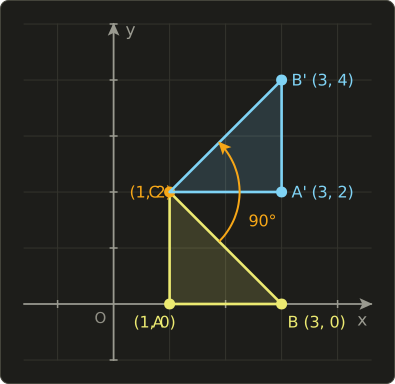
(B) is the clockwise rotation, (C) the rotation about the origin, (D) the product in the wrong order, , and (E) forgets to move back.
(2) C: S⁻¹R⁻¹T⁻¹
The inverse of a product is the product of the inverses in reverse order: undo the last step first (section 4.3, section 5.2).
Check: .
A keeps the original order, which doesn't cancel in general.
D is tempting because for a rotation, but the transpose of a translation or of a scaling isn't its inverse.
E isn't an inverse at all.
(3) A: (1, 2, 0)/√5
Normals transform with the inverse transpose, , followed by normalization (section 5.4):
Check it with a tangent of the face: is perpendicular to and becomes ; , still perpendicular.
B transforms the normal like a point, , and : it's no longer perpendicular to the stretched face.
Stretching x makes the face steeper relative to the x axis, so its normal turns towards y, not towards x.
(4) D is correct
A box with one face parallel to the projection plane has its width and height edges parallel to the plane, and those have no vanishing point; only the depth edges converge, to a single point (one-point perspective, section 5.8).
A mixes up the oblique projections: cabinet halves the depth, cavalier keeps it at full length (section 5.7).
B describes orthographic projection; in oblique projection the projectors are slanted.
C describes trimetric projection; isometric means three equal factors () with the axes 120° apart.
E is a property of parallel projections; perspective keeps straight lines but not ratios along them.
31.5 Problem 3: The pipelines, hidden surface removal and shading
(1) A: segment 1
With the bit order top, bottom, right, left of section 6.3, the endpoint codes are:
| Segment | Endpoints | Codes | AND | Result |
|---|---|---|---|---|
| 1 | , | 1000, 1010 | 1000 | trivially rejected |
| 2 | , | 0000, 0000 | 0000 | trivially accepted (OR = 0000) |
| 3 | , | 0001, 1000 | 0000 | must be clipped |
| 4 | , | 0001, 0010 | 0000 | must be clipped |
| 5 | , | 0100, 0010 | 0000 | must be clipped |
Both endpoints of segment 1 are above the top edge, so it can't reach the window.
The trap is segment 3: it's completely outside (its line passes above the corner ), but its endpoints lie on different sides, so AND is 0000 and the trivial test can't reject it.
The algorithm clips it to , gets with code 1000, and only then rejects it.
Segments 4 and 5 are partly visible: – and –.
(2) D is correct
Clipping happens in homogeneous clip space, inside when , before the perspective division; a point behind the camera has , and dividing by it would flip it into view (section 6.2, section 6.3).
A: back-face culling is complete only for a single convex object (section 10.1).
B: the scanline method needs the depths of one scanline only (section 10.4).
C: the painter's algorithm fails on interpenetration and cyclic overlap unless it splits polygons (section 10.2).
E: a BSP tree is view independent; it's built once, and only the traversal order depends on the eye (section 10.6).
(3) D: 0.82
The three terms of the Phong reflection model (section 10.10):
0.90 (E) forgets the exponent, 0.72 (B) the ambient term, 0.74 (C) squares the diffuse term too, and 0.50 (A) leaves out the specular term.
(4) C is wrong
The angle between and the half vector is about half the angle between and , so is closer to 1 and the Blinn–Phong exponent must be about four times the Phong exponent for a similar highlight, not a quarter (section 10.10).
A is the directional light of section 10.9, B the shininess, D the usual order for transparency (section 10.12) and E Lambert's view-independent diffuse term.
31.6 Problem 4: Shape models, solids, curves and surfaces
(1) B: (4, 4.75)
At the Bernstein weights are (section 8.4):
De Casteljau's algorithm gives the same: level 1 , level 2 , level 3 .
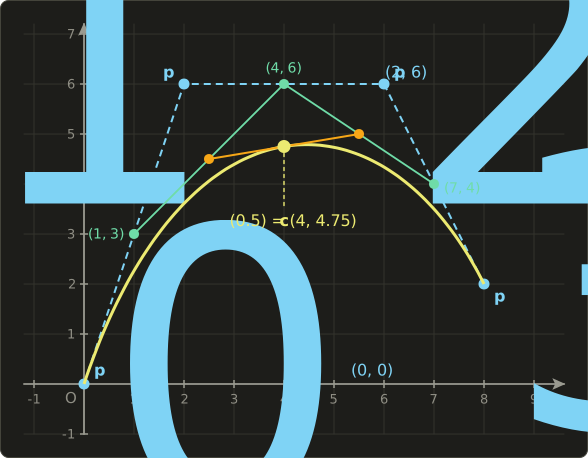
(A) is the plain average of the control points, (D) is a level-1 point, and (C) and (E) are the two level-2 points: the curve point is the midpoint between them.
(2) E: 2000
The Euler–Poincaré formula with , , gives (section 7.6).
Each triangle has 3 edges and each edge 2 triangles, so , :
1996 (A) is the sphere-like case without a hole, ; 3000 (B) is the number of edges; 2004 (D) would be a solid with two holes ().
(3) C is correct
A B-spline basis function is nonzero over only knot spans, so each cubic segment depends on four control points and each control point influences at most four segments: local control (section 8.5).
A: a Bézier curve has global control, because every Bernstein polynomial is nonzero on the whole open interval (section 8.4).
B: a Catmull–Rom spline interpolates its points and can leave their convex hull (section 8.7).
D: NURBS represent conics exactly, for example the quarter circle with the weights (section 8.6).
E is the wrong way round: (with a nonzero tangent) implies , but only requires equal tangent directions, not equal lengths (section 8.2).
(4) E is wrong
Euler's formula is necessary, not sufficient: a broken model can have the right counts by accident (section 7.6).
A and B are from section 7.3 (sweeps, conversions between representations), C from section 7.2 (regularized set operations take the closure of the interior) and D from section 7.7 (chamfer and fillet).
31.7 Problem 5: Polygon meshes, volumes and other shape representations
(1) B: 1/3
The bottom edge goes from 12 at to 36 at , so the value 20 is reached at (section 9.3):
The two right corners are at least 20 and the two left ones below it, so the isoline runs from the bottom edge to the top edge; on the top edge it crosses at , which is choice D.
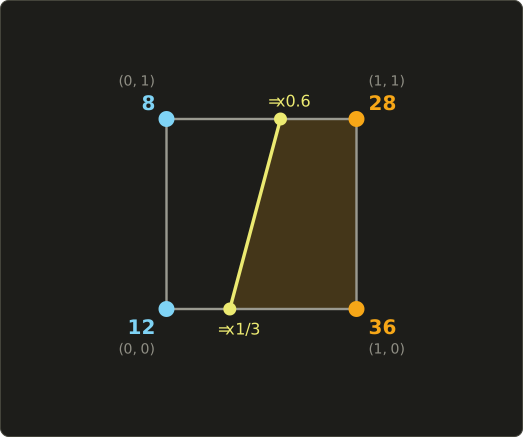
1/2 (C) puts the crossing at the midpoint without interpolating, and 2/3 (E) measures from the wrong end.
(2) E: popping
The sudden jump when a discrete LOD switches versions is popping (ポッピング); cross-fading or geomorphing hides it (section 9.1).
Aliasing (A) is a sampling artifact (section 2.6), z-fighting (B) the flicker of two surfaces at almost the same depth (section 10.3), ghosting (C) the double image of a cross-dissolve without warping (section 15.6), and Mach bands (D) the stripes the eye adds where the slope of brightness changes (section 3.9).
(3) E: log 5 / log 3
A shape made of copies of itself, each scaled by , has the similarity dimension (section 9.5).
Here and , so : between a curve and a filled area, as a fractal should be.
A is upside down, B forgets the logarithms, C () would keep all 9 squares (a filled square), and D uses the scale .
(4) B is wrong
A triangle strip needs indices for triangles: 3 for the first triangle and one more for each next one; is what separate triangles need (section 9.1).
A is true for Loop subdivision (section 9.2), C and D for voxels and octrees (, section 9.3) and E for metaballs (section 9.4).
31.8 Problem 6: Shadows, mapping, photorealistic rendering, global illumination and IBR
(1) B: level 4, 256 × 256
The footprint size is the longer of the two derivative vectors, and the level is its base-2 logarithm (section 11.7):
Level 4 of a 4096 × 4096 texture is texels wide.
Level 2 (A) uses the shorter side, which is what anisotropic filtering uses for its level (with samples along the long side), but the question excludes it.
Level 12 (E) is the 1 × 1 end of the chain: a 4096 texture has levels.
(2) A: 30°
At the critical angle the refracted ray would graze the surface, (section 12.5):
E has it backwards: total internal reflection happens exactly when light goes from the denser material into the less dense one.
(A diamond, with , has a critical angle of about 24°, which is why it sparkles.)
(3) B is correct
Photon mapping is a two-pass method: photon tracing from the lights, then rendering with density estimation from the photon map; caustics are its strength (section 12.12).
A: Whitted ray tracing uses point lights, and one shadow ray per light gives hard shadows; soft shadows need many shadow rays that sample the area of the light (section 11.5, section 12.10).
C: Monte Carlo noise falls as ; 4 times the samples halve it (section 12.10).
D describes a sphere map; a cube map stores six faces and doesn't depend on the viewing direction (section 11.9).
E: a panorama lets you look around from a fixed point, not move (section 12.13).
(4) E: shadow acne
Self-shadowing stripes caused by the limited resolution and precision of the shadow map are shadow acne (シャドウアクネ), and the opposite error caused by too much bias is peter panning (B) (section 11.4).
Z-fighting (A) happens between two different surfaces in the Z-buffer, and the penumbra (D) is the partly lit edge of a soft shadow (section 11.1).
31.9 Problem 7: Animation
(1) A: 2.5 m
Semi-implicit Euler updates the velocity first and moves with the new velocity (section 14.2):
Explicit Euler moves with the old velocity: , (D).
The exact height after 1 s is m (C): the two first-order methods miss it by the same 2.5 m in opposite directions.
(2) D: (1, 1)
Linear blend skinning averages the positions that each bone's skinning matrix gives (section 13.8):
The vertex is now only from the joint instead of 2: averaging positions instead of rotations cuts the corner, which is the volume loss at bends that leads to the candy-wrapper artifact and to dual quaternion skinning.
(C) is where a rotation by 45° would put it, and (A, B) follow one bone only (rigid binding), and (E) forgets the weights.
(3) B: 3.0
Differentiate with respect to , then convert to frames with (section 13.3):
The average speed is m per frame (A, linear interpolation), and the smoothstep curve peaks at 1.5 times the average, in the middle.
30 (E) forgets to convert from to frames.
(4) C is wrong
Rotoscoping draws the matte by hand, frame by frame, and needs no screen at all; that's exactly why it's used for footage without one (section 14.10).
A is the fixed time step (section 14.8), B boids (section 14.9), D matchmoving (section 14.10) and E inverse kinematics (section 13.7).
31.10 Problem 8: Image processing
(1) B: 50
Sort the nine values of the window: 10, 20, 20, 30, 50, 60, 60, 70, 255; the fifth is the median (section 15.5).
The spike can't pull it: it simply lands at the end of the list.
64 (D) is the mean, , which the single spike drags far up; that's why the median is the filter for salt-and-pepper noise.
(2) C: 200
With the weights 1, 2, 1 (section 15.5):
280 (D) is the approximation , 40000 (E) forgets the square root, and 120 and 160 (A, B) are only one component each.
The center weight of both Sobel kernels is 0, so the spike itself doesn't enter this value (but it does disturb the gradients of its neighbors).
(3) C: bilateral
The bilateral filter multiplies the Gaussian weight of the distance by a second Gaussian of the difference in value, so pixels across an edge get almost no weight (section 15.5).
The Gaussian filter (A) weights by distance only and blurs edges; the median (B) keeps edges too, but sorts instead of weighting; Laplacian and Sobel (D, E) are derivative filters for finding edges, not for smoothing.
(4) D is wrong
Opening is erosion followed by dilation, and it removes small specks and thin protrusions; dilation followed by erosion is closing, which fills small holes (section 15.5).
A, B (border handling), C (separability) and E (unsharp masking) are all true and in the same section.
31.11 Problem 9: Computational photography, NPR and visualization
(1) E: 16
Averaging frames with independent noise divides its standard deviation by (section 16.6):
4 (B) would be right if the noise fell as .
(2) C: (4, 3, 2, 3)
Dynamic programming adds to each pixel the smallest cumulative energy among its up to three neighbors in the row above (section 16.7):
| x = 0 | x = 1 | x = 2 | x = 3 | x = 4 | |
|---|---|---|---|---|---|
| y = 0 | 4 | 1 | 9 | 5 | 3 |
| y = 1 | 6 | 7 | 7 | 5 | 7 |
| y = 2 | 8 | 14 | 6 | 10 | 9 |
| y = 3 | 13 | 13 | 15 | 9 | 14 |
The smallest value in the last row is 9 at ; tracing back through the smallest neighbors gives (6), (5), (3): the seam with .
B has the smaller sum , but jumps from to , so it isn't a connected seam.
A is what a greedy search finds by starting at the smallest top value and always stepping to the cheapest neighbor: ; D costs 11 and E 15.
(3) A is wrong
A crease edge is found from the angle between the normals of its two faces, which doesn't depend on the viewpoint, so crease edges can be computed once; it's the silhouette edges that change with the view (section 16.10).
B is toon shading (section 16.9), C image-space outlines (section 16.10), D stippling (section 16.12) and E Gooch shading (section 16.11).
(4) E is correct
The transfer function maps each data value to a color and an opacity, and the ray compositing does the rest (section 16.15).
A: the rainbow map's lightness goes up and down, which creates false boundaries; perceptually uniform maps such as viridis are better (section 16.14).
B: MIP shows only the maximum along each ray, without any depth cues (section 16.15).
C describes scientific visualization; information visualization deals with abstract data whose layout the designer chooses (section 16.13).
D describes direct volume rendering; an isosurface shows one value as an opaque surface (section 16.14).
31.12 Problem 10: CG systems, perception, intellectual property and history
(1) B: 5 m
Depth is inversely proportional to disparity (section 17.5):
0.2 m (A) is the formula upside down, 80 m (D) forgets the disparity, and 1280 m (E) multiplies by it.
A point at 10 m (C) would have half the disparity, 8 pixels.
(2) A is correct
A patent lasts 20 years from the filing date (section 18.8).
B: since the 2020 amendment, a design right lasts 25 years from filing.
C: a trademark lasts 10 years from registration but can be renewed again and again.
D: only copyright arises automatically; the four industrial property rights need an application and registration at the Japan Patent Office (section 18.6).
E: a utility model is registered without substantive examination and lasts 10 years from filing.
(3) D: P → Q → R → S
Gouraud shading (1971), Catmull's Z-buffer (1974), Whitted's ray tracing (1980), Kajiya's rendering equation (1986) (section 18.10).
Don't confuse Whitted's recursive ray tracing with Appel's ray casting (1968), which is older than all four.
(4) C is wrong
The threads of a warp run in lockstep; when they diverge, the warp runs both paths one after the other, with the threads that didn't take the current path masked off, so divergence costs time (section 17.2).
A and B are from section 17.4, D from section 17.5 and E from section 18.2.
31.13 Answers to the chapter questions
Below are the answers to the multiple-choice questions at the end of chapters 1 to 29, chapter by chapter, each with a one-line reason and a link to its chapter.
Chapter 1: Introduction: Computer Graphics and the CG Engineer Exam
| Question | Answer | Why |
|---|---|---|
| Q1 | A | Computer vision goes from an image to a description of what's in it; B is image processing and C is rendering. |
| Q2 | E | You make the models, set up the layout and the camera, animate, render, and composite the rendered layers last. |
| Q3 | C | Transposing reverses the order: ; B forgets to reverse it. |
Chapter 2: The Digital Camera Model and Digital Images
| Question | Answer | Why |
|---|---|---|
| Q1 | D | Quantization rounds each measured value to one of a finite number of levels; A is sampling and B is demosaicing. |
| Q2 | A | The sampling frequency must be more than twice the highest frequency, 30 kHz, and only 40 kHz is. |
| Q3 | E | A larger f-number means a smaller aperture, which deepens the depth of field; A and B make it shallower. |
Chapter 3: Color and Visual Perception
| Question | Answer | Why |
|---|---|---|
| Q1 | E | Light mixes additively, and red plus green light gives yellow; cyan plus magenta ink gives blue, not green (B). |
| Q2 | B | The curved edge is the locus of monochromatic lights, and the colors on the straight line joining its ends need two wavelengths. |
| Q3 | A | The sRGB encoding gives and ; 128 (D) forgets the encoding. |
Chapter 4: 2D Coordinate Transformations
| Question | Answer | Why |
|---|---|---|
| Q1 | B | Affine maps keep parallel lines parallel, while projective maps can make them meet; A and C hold for both. |
| Q2 | E | The rotation takes to and the translation to ; translating first gives (A). |
| Q3 | D | , and y is flipped: ; A forgets the flip. |
Chapter 5: 3D Transformations and Projection
| Question | Answer | Why |
|---|---|---|
| Q1 | A | Isometric projection foreshortens all three axes equally, drawn 120° apart; in dimetric projection (D) only two are equal. |
| Q2 | C | Normals are transformed with the inverse transpose ; itself tilts them under non-uniform scaling. |
| Q3 | E | Only lines parallel to the projection plane stay parallel; every other family of parallel lines meets at a vanishing point. |
Chapter 6: The Viewing and Drawing Pipelines
| Question | Answer | Why |
|---|---|---|
| Q1 | E | Clipping is done in clip coordinates before the perspective division, and the viewport transform comes last; C divides too early. |
| Q2 | D | A common 1 bit in the AND means both endpoints are beyond the same edge, so the segment is rejected at once; an AND of 0000 (B) proves nothing. |
| Q3 | B | , so the next pixel is the upper one, . |
Chapter 7: Shape Models and Solid Representations
| Question | Answer | Why |
|---|---|---|
| Q1 | A | Only a solid model knows the inside from the outside, which volume, mass and interference checks need. |
| Q2 | E | : , so . |
| Q3 | C | A winged edge stores 2 vertices, 2 faces and 4 wing edges; a half-edge stores only its own face, and its twin belongs to the other one (A, D). |
Chapter 8: Curves and Surfaces
| Question | Answer | Why |
|---|---|---|
| Q1 | E | The Bernstein weights are non-negative and add up to 1, so the curve stays inside the convex hull; it passes only through and (A). |
| Q2 | A | Catmull–Rom passes through every point and each segment depends on only four points; a B-spline (C) doesn't interpolate, and a natural spline (D) is global. |
| Q3 | B | At the joint the tangents are and : the same direction but different lengths, so but not . |
Chapter 9: Polygon Meshes, Volumes and Other Shape Representations
| Question | Answer | Why |
|---|---|---|
| Q1 | D | Marching cubes classifies the 8 corners of each cube (256 cases) and looks up the triangles in a table; C is direct volume rendering. |
| Q2 | A | Loop subdivision is for triangle meshes, whose regular vertices have valence 6; in Catmull–Clark the regular valence is 4 (C). |
| Q3 | E | . |
Chapter 10: Hidden Surface Removal and Shading
| Question | Answer | Why |
|---|---|---|
| Q1 | E | The depth test is made pixel by pixel, so polygons that pass through each other need no splitting; no sorting is needed, but semi-transparent polygons still need an order (B). |
| Q2 | A | Gouraud shading interpolates vertex colors, so a highlight in the middle of a polygon can disappear; B describes Phong shading. |
| Q3 | C | , and ; E forgets . |
Chapter 11: Shadows and Mapping
| Question | Answer | Why |
|---|---|---|
| Q1 | A | Shadow mapping renders depths from the light, then compares each point's light-space depth with them; it does suffer from aliasing (E). |
| Q2 | D | Displacement mapping really moves the surface, so the silhouette and the shadows change; bump and normal mapping only change the normals. |
| Q3 | E | A footprint of 8 texels is levels down, ; the mipmap needs about 4/3 of the memory (B) and has 11 levels (C). |
Chapter 12: Photorealistic Rendering and Global Illumination
| Question | Answer | Why |
|---|---|---|
| Q1 | D | Radiosity solves the diffuse interreflection on the surfaces themselves, so its solution doesn't depend on the viewpoint; Whitted ray tracing has no diffuse bounces (A). |
| Q2 | B | The reciprocity holds; the form factor is pure geometry, independent of albedo and light color. |
| Q3 | E | Radiance is constant along a ray in free space, so 4 dimensions suffice, e.g. two planes; B is the full plenoptic function. |
Chapter 13: Animation 1: Keyframes, Kinematics and Characters
| Question | Answer | Why |
|---|---|---|
| Q1 | B | An interpolating spline such as Catmull–Rom can overshoot the key values between two keys; linear interpolation (C) makes the speed jump at the keys. |
| Q2 | E | IK goes from the target to the joint angles, and a reachable two-link target usually has two solutions; an arm with links 3 and 2 can't reach points closer than 1 (B). |
| Q3 | A | Linear blend skinning averages the transformed positions, which loses volume at strongly bent or twisted joints (the candy-wrapper effect). |
Chapter 14: Animation 2: Physics, Procedural Animation and Compositing
| Question | Answer | Why |
|---|---|---|
| Q1 | C | Explicit Euler adds energy to an undamped spring every step; a smaller step or semi-implicit Euler helps, though not for any step (D). |
| Q2 | A | Boids follow only local rules, and the flock emerges from them; alignment matches the neighbors' velocity, and steering toward their average position (C) is cohesion. |
| Q3 | D | Matchmoving recovers the real camera from tracked features; A gives chroma key the job of matchmoving, and B describes keying, not rotoscoping. |
Chapter 15: Image Processing
| Question | Answer | Why |
|---|---|---|
| Q1 | E | The median ignores outliers such as salt-and-pepper noise and doesn't average across edges; Sobel is a first-derivative filter (A). |
| Q2 | B | Equalization uses the normalized cumulative histogram as the tone curve and can merge levels but never add any; Otsu maximizes the between-class variance (C). |
| Q3 | D | Inverse mapping visits every output pixel and samples the input there, so nothing is left empty; forward mapping leaves holes when enlarging (A). |
Chapter 16: Computational Photography, NPR and Visualization
| Question | Answer | Why |
|---|---|---|
| Q1 | A | Each linearized exposure estimates the radiance as its value divided by the exposure time, with low weights for clipped or dark pixels; moving objects cause ghosts (E). |
| Q2 | C | A silhouette edge lies between a front-facing and a back-facing face; the inverted hull culls the front faces, not the back faces (D). |
| Q3 | E | and : the second sample is weighted by its opacity and by the remaining transparency 0.6. |
Chapter 17: CG Systems
| Question | Answer | Why |
|---|---|---|
| Q1 | D | From , a one-pixel disparity error gives a depth error roughly proportional to ; far points have a smaller disparity (E). |
| Q2 | E | With a variable refresh rate the display waits for the finished frame, so there is neither tearing nor the wait for the next fixed refresh; C would be shown after 33.3 ms. |
| Q3 | B | In SLS the unfused powder holds up overhangs, so polymer parts need no separate supports; A describes vat photopolymerization and D describes FDM. |
Chapter 18: Perception, Intellectual Property and the History of CG
| Question | Answer | Why |
|---|---|---|
| Q1 | B | Apparent motion makes slightly different still frames look like continuous motion; foveated rendering (C) lowers the resolution in the periphery. |
| Q2 | A | Copyright arises automatically when the work is created; moral rights can't be transferred (B), and the term is 70 years after death (C). |
| Q3 | C | Toy Story (1995) was the first feature film made entirely with computer animation; hardware T&L came before programmable shaders (D). |
Chapter 19: Projection and Rasterization in Depth
| Question | Answer | Why |
|---|---|---|
| Q1 | D | Clip coordinates are a linear function of camera coordinates, so linear interpolation there is correct; clipping comes before the division (A). |
| Q2 | A | Reversed Z puts the far range near 0, where floats are densest, so one depth step stays roughly proportional to the distance; a closer near plane (C) makes things worse. |
| Q3 | C | Interpolate and on the screen: ; 0.5 (A) is the screen-linear value. |
Chapter 20: Anti-Aliasing and Real-Time Transparency
| Question | Answer | Why |
|---|---|---|
| Q1 | E | MSAA tests coverage and depth per sample but shades once per pixel and triangle, which is why it doesn't remove shading aliasing (B). |
| Q2 | B | TAA jitters the projection every frame and blends with the history reprojected by motion vectors; it can cause ghosting and blur (E). |
| Q3 | A | The weighted average times the coverage gives ; D forgets the coverage. |
Chapter 21: Mesh Processing and Signed Distance Fields
| Question | Answer | Why |
|---|---|---|
| Q1 | A | QEM sums the plane quadrics per vertex, adds the two for a collapse, and the error of the new position is the cost; flat regions have almost no error (E). |
| Q2 | D | With a 1-Lipschitz function a step of its value never jumps over the surface, but grazing rays approach slowly; an underestimate (A) is safe, only slower. |
| Q3 | B | , so ; C forgets the last term. |
Chapter 22: Physically Based Shading
| Question | Answer | Why |
|---|---|---|
| Q1 | C | A metal has no diffuse reflection and uses its base color as F0; for a dielectric F0 is about 0.04 and the base color is the diffuse color, which D swaps. |
| Q2 | E | G accounts for the shadowing and masking of microfacets by other microfacets; F is evaluated with the half vector, not with n (B). |
| Q3 | D | The BRDF table depends only on and the roughness, so one table serves every environment; only the prefiltered map changes (C). |
Chapter 23: Monte Carlo Rendering
| Question | Answer | Why |
|---|---|---|
| Q1 | B | The estimator is unbiased whenever where ; its error falls as , not as (A, D). |
| Q2 | A | The balance heuristic weights are and add up to 1; arbitrary weights that don't add up to 1 (B) bias the result. |
| Q3 | E | Progressive photon mapping shrinks its radius pass by pass, so its bias goes to zero: it is consistent; Russian roulette (B) stays unbiased. |
Chapter 24: Real-Time Shadows, Ambient Occlusion and Global Illumination
| Question | Answer | Why |
|---|---|---|
| Q1 | D | PCSS estimates the penumbra from the average blocker depth and the light size, so shadows stay sharp at contact; a fixed PCF kernel (C) can't. |
| Q2 | C | GTAO integrates the cosine-weighted visibility between the two horizons analytically, so only the slice directions are sampled; AO doesn't depend on the lights (A). |
| Q3 | A | Convolution with the clamped cosine damps the bands above L2 strongly, so 9 SH coefficients per channel approximate the irradiance well. |
Chapter 25: Advanced Character Animation
| Question | Answer | Why |
|---|---|---|
| Q1 | E | DQS blends rigid transforms and normalizes, which avoids the candy-wrapper collapse (C) at the cost of a slight bulge, with the same weights as LBS (B). |
| Q2 | D | Motion matching searches the database for the frame whose features best match the query; it needs no hand-built state machine (C). |
| Q3 | B | Damped least squares adds , which keeps the steps bounded near singular poses at the price of slower convergence; FABRIK uses no Jacobian (A). |
Chapter 26: Physics Simulation
| Question | Answer | Why |
|---|---|---|
| Q1 | A | Implicit Euler is stable at any step but damps the oscillation numerically; explicit Euler is unstable for an undamped spring at any step (B). |
| Q2 | B | The accumulated normal impulse is clamped to be non-negative and the friction impulse to times it; box against box needs 15 SAT axes, not 6 (A). |
| Q3 | C | FLIP adds the grid's velocity change to the particles (detail but noise), PIC copies the grid velocity (smooth but dissipative); semi-Lagrangian advection traces backward and is stable for any CFL number (A). |
Chapter 27: HDR and Advanced Image Processing
| Question | Answer | Why |
|---|---|---|
| Q1 | C | Per-channel curves compress each channel on its own and push bright colors toward white, while a luminance curve keeps the ratios; Reinhard maps 1 to 0.5, not to white (A). |
| Q2 | A | PQ is absolute: each code value means a fixed luminance in cd/m²; HLG is scene-referred and relative to the display's peak (B). |
| Q3 | E | Convolution becomes multiplication of the DFTs, and with zero padding and the FFT this beats direct convolution for large kernels; BC1 takes 8 bytes per block, not 32 (B). |
Chapter 28: Volume Rendering and Advanced NPR
| Question | Answer | Why |
|---|---|---|
| Q1 | B | Optical depths add along a ray, so the transmittances multiply; the extinction coefficient is absorption plus scattering (A). |
| Q2 | E | and , so the ratio is ; is the mean cosine, not a fraction of the light (B). |
| Q3 | D | The Kuwahara filter takes the mean of the least-varying subregion, so it never averages across an edge; the tones of a tonal art map are nested, not unrelated (A). |
Chapter 29: Modern GPU Systems and Neural Rendering
| Question | Answer | Why |
|---|---|---|
| Q1 | D | More registers per thread leave room for fewer resident warps per block, so less memory latency can be hidden; higher occupancy isn't always faster (B). |
| Q2 | C | A ray query traces a ray inline from an ordinary shader, which examines the result itself without a shader binding table; A swaps the BLAS and the TLAS. |
| Q3 | E | A sample's weight is its alpha times the transmittance in front of it, and behind an almost opaque surface ; A describes 3D Gaussian splatting, not NeRF. |
31.14 A final word
That's the end of the series.
Part 1 covered every item of the Expert syllabus, from the camera model to the history of CG, and Part 2 went beyond it into the techniques behind today's renderers.
If you've worked through both, you know not only the answers the exam wants, but why they are the answers.
What to do next:
- Use the official material. Solve the official problem collection (公式問題集) for the Expert level, and the past exams with their answers from the official site, under the real conditions (80 minutes and no calculator at the time of writing). Check the current exam information there too.
- Close the gaps. For every question you miss, go back to the section of this series (or of the official textbook) that teaches it, until you can explain why each wrong choice is wrong.
- Build it yourself. Theory sticks best when you implement it. The GLSL series turns shading, color and procedural textures into shaders, and the OpenGL series builds the whole pipeline: transforms, the depth buffer, textures, shadows and animation.
Good luck with the exam, and have fun making pictures.
コメント(0)
まだコメントはありません。
ログインするとコメント出来ます。