30. Mini-Exam
This is the mini-exam I promised in chapter 1: 40 questions in the style of the CG Engineer Certification, Expert level, weighted by syllabus area.
It's a check of the whole of Part 1 in one sitting, under exam conditions, so you find out what you can really do without the book open.
The answers, with an explanation for every question and a link to the section that teaches it, are in chapter 31.
30.1 Before you start
What it covers
The exam syllabus is covered by Part 1 of this series, chapters 2 to 18, so that's the scope of this mini-exam.
Part 2 (chapters 19 to 29) goes beyond the syllabus, and you don't need it for any question here.
There are 10 main problems (大問, daimon), one per area group, each with 4 questions (小問, shōmon):
| Problem | Area | Chapters |
|---|---|---|
| 1 | The digital camera model, digital images and color | 2, 3 |
| 2 | 2D and 3D transformations and projection | 4, 5 |
| 3 | The viewing and drawing pipelines, hidden surface removal and shading | 6, 10 |
| 4 | Shape models, solids, curves and surfaces | 7, 8 |
| 5 | Polygon meshes, volumes and other shape representations | 9 |
| 6 | Shadows, mapping, photorealistic rendering, global illumination and IBR | 11, 12 |
| 7 | Animation | 13, 14 |
| 8 | Image processing | 15 |
| 9 | Computational photography, NPR and visualization | 16 |
| 10 | CG systems, perception, intellectual property and the history of CG | 17, 18 |
How to take it
- Paper and pencil. Print the page or keep it on a screen, and write your answers on a sheet of paper (the answer grid below). Do the calculations on scrap paper.
- No calculator, no notes. At the time of writing, the instructions printed on the Expert exam papers published on the official site forbid calculators and other electronic devices, so this mini-exam doesn't allow them either. Every calculation here is designed to be done by hand. Close the other chapters too.
- 80 minutes. At the time of writing, the same instructions give 80 minutes for one exam (150 minutes if you take two exams on the same day). Set a timer and stop when it rings, even if you haven't finished: pacing is part of the test.
- One answer per question. Every question has five choices, exactly one of which is correct. Some ask for the correct statement, some for the wrong one: read the question to the end.
- Scoring. Each question is worth 2.5 points, 100 in all. As in the real exam at the time of writing, 70 points (28 correct answers) is the pass line.
Copy this grid and fill in a letter for every question:
| Problem | (1) | (2) | (3) | (4) |
|---|---|---|---|---|
| 1 | ||||
| 2 | ||||
| 3 | ||||
| 4 | ||||
| 5 | ||||
| 6 | ||||
| 7 | ||||
| 8 | ||||
| 9 | ||||
| 10 |
About these questions
All questions and figures in this chapter are my own: they are not past exam questions and not exercises from the official textbook, only written in a similar style.
The real exam's wording, figures and difficulty can differ, and its emphasis changes from session to session.
So treat this as a self-check, not as a forecast.
The real preparation is the official material: the Expert problem collection (公式問題集) and the past exams with their answers, which can be downloaded from the official site.
Solve at least one past exam under the same conditions as this one.
Problem 1: The digital camera model, digital images and color
A small studio photographs a brick wall to make a texture for a game.
The camera's image sensor is 36 mm wide; it measures the light at a regular grid of positions and stores each measurement as a whole number.
By the sampling theorem, a pattern is reproduced correctly only if the sampling frequency is more than twice the highest frequency it contains; half of the sampling frequency is called the (a).
Patterns finer than that show up as false, coarser patterns such as moiré.
(1) Which term goes in blank (a)?
| A | sampling frequency |
| B | cutoff frequency |
| C | spatial frequency |
| D | Nyquist frequency |
| E | resolution |
(2) The camera's lens has a focal length of 18 mm and is focused on a distant subject. Treating the camera as a pinhole camera at that focal length, what is the horizontal angle of view of the 36 mm wide sensor?
| A | 90° |
| B | 45° |
| C | 53.1° |
| D | 120° |
| E | 126.9° |
(3) The photo is stored without compression as 1600 × 1200 pixels in YCbCr with 4:2:0 chroma subsampling and 8 bits per value. How many bytes does it take?
| A | 1,920,000 |
| B | 5,760,000 |
| C | 3,840,000 |
| D | 23,040,000 |
| E | 2,880,000 |
(4) Which of the following statements about color and its perception is wrong?
| A | Two lights with different spectral distributions can look exactly the same color (metamerism). |
| B | Rods work in dim light and don't distinguish colors; color vision in daylight comes from three kinds of cones. |
| C | By Weber's law, the smallest noticeable difference in intensity is roughly proportional to the intensity itself. |
| D | A light with a lower color temperature looks bluer, and a light with a higher color temperature looks redder. |
| E | In both the BT.601 and the BT.709 luma formulas, green has the largest coefficient. |
Problem 2: 2D and 3D transformations and projection
The figure shows the triangle ABC with , and in a coordinate system with y up.
We use column vectors and homogeneous coordinates, positive angles are counterclockwise, is the translation by and the rotation by about the origin.
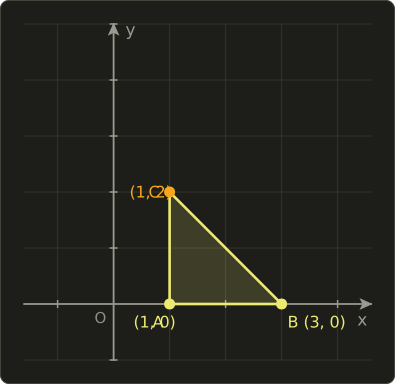
(1) The triangle is rotated by 90° counterclockwise about its vertex C, with the matrix , where . Where does the vertex B end up?
| A | |
| B | |
| C | |
| D | |
| E |
(2) A shape is first scaled by , then rotated by , then translated by , so its composite matrix is (all three invertible). The matrix that undoes the whole transformation is (a). Which expression goes in (a)?
| A | |
| B | |
| C | |
| D | |
| E |
(3) A 3D object is scaled by the matrix , which doubles x. Before the scaling, one of its faces had the unit normal . What is the unit normal of that face after the scaling?
| A | |
| B | |
| C | |
| D | |
| E |
(4) Which of the following statements about projections is correct?
| A | In cavalier projection, lines along the depth axis are drawn at half their true length. |
| B | In oblique projection, the projectors are perpendicular to the projection plane. |
| C | In isometric projection, the three coordinate axes are foreshortened by three different factors. |
| D | In perspective projection, a box with one face parallel to the projection plane has exactly one vanishing point. |
| E | Perspective projection preserves the ratio in which a point divides a line segment. |
Problem 3: The pipelines, hidden surface removal and shading
A renderer sends its vertices through the viewing pipeline, clips the primitives, removes hidden surfaces and shades what remains.
For question (1), the figure shows a clipping window , and five line segments, numbered 1 to 5.
They are clipped with the Cohen–Sutherland algorithm, which gives each endpoint a 4-bit outcode.
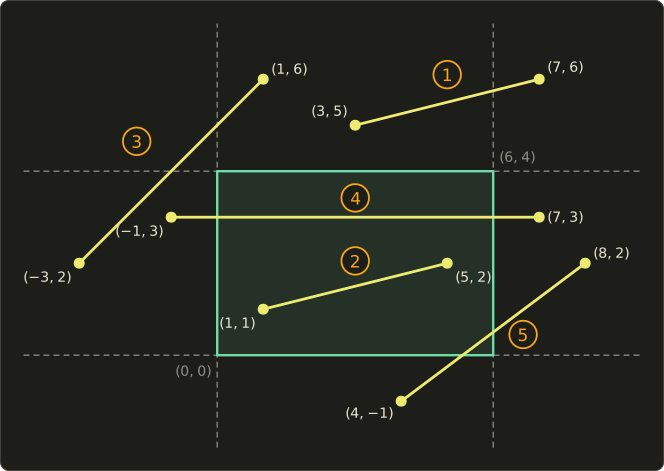
(1) Which segment does the Cohen–Sutherland algorithm reject by its trivial test, without computing any intersection?
| A | segment 1 |
| B | segment 2 |
| C | segment 3 |
| D | segment 4 |
| E | segment 5 |
(2) Which of the following statements is correct?
| A | Back-face culling alone removes all hidden surfaces of any scene. |
| B | The scanline method needs a depth buffer as large as the whole screen. |
| C | The painter's algorithm draws polygons that pass through each other correctly, without splitting them. |
| D | Clipping is done in homogeneous clip space before the perspective division, so points behind the camera () are dealt with before anything is divided by . |
| E | A BSP tree must be rebuilt every time the viewpoint moves. |
(3) A surface point is lit by one light with the Phong reflection model. The unit normal is , the unit vector to the light is and the unit vector to the eye is . The constants are , , , , and , with no attenuation. What is the reflected intensity ?
| A | 0.50 |
| B | 0.72 |
| C | 0.74 |
| D | 0.82 |
| E | 0.90 |
(4) Which of the following statements about light sources, reflection and transparency is wrong?
| A | A directional light has a direction but no position, and its intensity doesn't fall off with distance, which suits the sun. |
| B | In the Phong reflection model, a larger shininess gives a smaller, sharper highlight. |
| C | The Blinn–Phong model uses the half vector instead of the reflection vector; for a similar highlight, its exponent must be about a quarter of the Phong exponent. |
| D | Semi-transparent surfaces are usually drawn after the opaque ones, from back to front, with depth writes turned off. |
| E | The diffuse term given by Lambert's cosine law doesn't depend on the viewing direction. |
Problem 4: Shape models, solids, curves and surfaces
A modeling tool stores solids as boundary representations and lets the user draw cubic Bézier curves.
The figure shows the control polygon of one such curve, with .
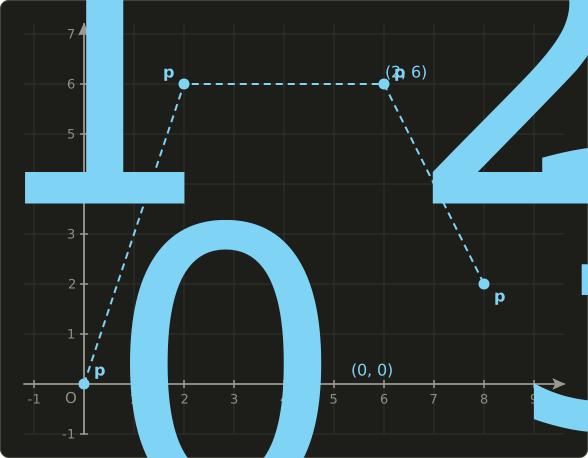
(1) What is the point of the curve in the figure?
| A | |
| B | |
| C | |
| D | |
| E |
(2) A closed triangle mesh is the boundary of a ring-shaped solid with exactly one hole through it (one shell, no rings, one hole). It has vertices, every face is a triangle and every edge belongs to exactly two faces. How many triangles does it have?
| A | 1996 |
| B | 3000 |
| C | 1000 |
| D | 2004 |
| E | 2000 |
(3) Which of the following statements about curves is correct?
| A | A Bézier curve has local control: moving one control point changes only the nearby part of the curve. |
| B | A Catmull–Rom spline always lies inside the convex hull of its control points. |
| C | Each segment of a uniform cubic B-spline depends on only four control points, so moving one control point changes only part of a curve that has many segments. |
| D | A circle can't be represented exactly, even with NURBS. |
| E | Two curve segments joined with continuity are always continuous as well. |
(4) Which of the following statements about solid modeling is wrong?
| A | A translational sweep of a 2D profile makes an extruded solid, and a rotational sweep makes a solid of revolution. |
| B | Converting a CSG tree into a B-rep is routine, but converting a B-rep into a CSG tree is hard. |
| C | Regularized set operations remove dangling faces and edges from their results. |
| D | A chamfer replaces an edge with a flat face; a fillet replaces it with a curved face tangent to both neighboring faces. |
| E | If the numbers of vertices, edges and faces of a B-rep satisfy Euler's formula, the model is guaranteed to be a valid solid. |
Problem 5: Polygon meshes, volumes and other shape representations
A scalar field has been sampled on a grid, and its isoline for the value 20 is extracted with marching squares, interpolating linearly along the cell edges.
The first figure shows one cell of the grid, of side 1, with the sampled values at its corners.
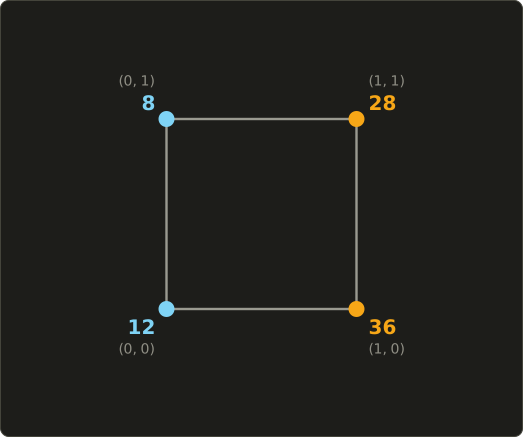
(1) At which does the isoline cross the bottom edge of the cell, from to ?
| A | |
| B | |
| C | |
| D | |
| E |
(2) A game keeps several versions of a mesh with different numbers of triangles and switches between them by distance (level of detail). When the switch is abrupt, the visible sudden change of the shape is called (a). Which term goes in (a)?
| A | aliasing |
| B | z-fighting |
| C | ghosting |
| D | Mach bands |
| E | popping |
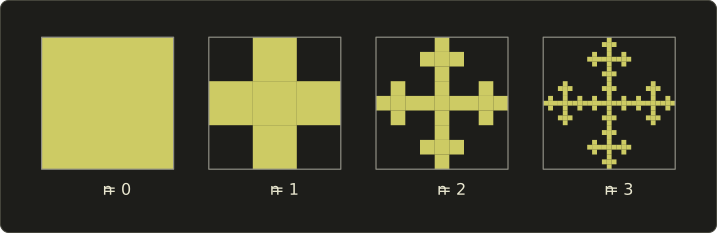
(3) The second figure shows a fractal built by replacing, at every step, each square with 5 squares of 1/3 its side (the center and its four edge neighbors in a 3 × 3 grid). What is its similarity dimension?
| A | |
| B | |
| C | |
| D | |
| E |
(4) Which of the following statements is wrong?
| A | Loop subdivision splits each triangle into four triangles in every step. |
| B | A triangle strip of triangles needs indices. |
| C | Doubling the resolution of a voxel grid along each axis multiplies the number of voxels by 8. |
| D | An octree divides a cube that is only partly occupied into 8 smaller cubes. |
| E | Metaballs add up the field functions of several centers and take the surface where the sum equals a threshold. |
Problem 6: Shadows, mapping, photorealistic rendering, global illumination and IBR
A scene is rendered in real time with textures and shadow mapping, and offline with a global illumination renderer.
(1) A 4096 × 4096 texture has a full mipmap; level 0 is the original. At one pixel, moving one pixel to the right moves the texture coordinates by texels, and moving one pixel down moves them by texels. Without anisotropic filtering, which level does the GPU choose, and how large is it?
| A | level 2, 1024 × 1024 |
| B | level 4, 256 × 256 |
| C | level 5, 128 × 128 |
| D | level 8, 16 × 16 |
| E | level 12, 1 × 1 |
(2) Light travels inside a transparent material with refractive index 2 and hits its boundary with air (refractive index 1). What is the critical angle for total internal reflection?
| A | 30° |
| B | 45° |
| C | 60° |
| D | 90° |
| E | There is none: total internal reflection can't happen when light goes from this material into air. |
(3) Which of the following statements is correct?
| A | Whitted ray tracing produces the soft shadows of area lights, because it traces one shadow ray to each light. |
| B | Photon mapping traces photons from the lights and stores them in a first pass, then estimates the radiance from the density of nearby photons in a second pass; it handles caustics well. |
| C | In path tracing, the noise falls in proportion to for samples per pixel. |
| D | A cube map stores the whole environment in one image whose content depends on the viewing direction. |
| E | A panorama image lets the viewer walk freely through the scene, not only look around. |
(4) In shadow mapping, each texel of the shadow map stores one depth, so a lit surface that is tilted relative to the light can shadow itself in stripes or moiré. This artifact is called (a). A depth bias removes it, but too much bias makes the shadow start away from the base of an object. Which term goes in (a)?
| A | z-fighting |
| B | peter panning |
| C | Mach bands |
| D | penumbra |
| E | shadow acne |
Problem 7: Animation
A game contains a ball that is simulated with physics, a skinned character and a camera move animated with keyframes.
(1) The ball is thrown straight up from height with velocity m/s. Its acceleration is m/s² (take ). The simulation uses the semi-implicit (symplectic) Euler method with the time step s. What is the height of the ball after two steps?
| A | 2.5 m |
| B | 3.75 m |
| C | 5.0 m |
| D | 7.5 m |
| E | 10.0 m |
(2) In 2D, the character's elbow joint is at the origin. In the bind pose, a skin vertex is at and the skinning matrices of both bones are the identity. The vertex is bound to bone 1 and bone 2 with weights 0.5 each. Bone 1 doesn't move, and bone 2 rotates by 90° counterclockwise about the joint. Where is the vertex with linear blend skinning?
| A | |
| B | |
| C | |
| D | |
| E |
(3) The camera moves from 0 m at frame 0 to 20 m at frame 10 along the ease-in/ease-out curve with . What is its highest speed, in meters per frame?
| A | 2.0 |
| B | 3.0 |
| C | 4.0 |
| D | 6.0 |
| E | 30 |
(4) Which of the following statements is wrong?
| A | With a fixed time step and an accumulator, a game's physics advances in the same steps independently of the frame rate (as long as the frame rate doesn't drop too low). |
| B | In Reynolds' boids, each bird follows separation, alignment and cohesion using only its nearby flockmates, without a leader. |
| C | Rotoscoping can only be used on footage shot in front of a blue or green screen. |
| D | Matchmoving recovers the position, orientation and focal length of the real camera for every frame, from features tracked in the footage. |
| E | Inverse kinematics computes joint angles from a desired end-effector position; chains with more joints than the target needs are redundant and are often solved iteratively, for example with CCD. |
Problem 8: Image processing
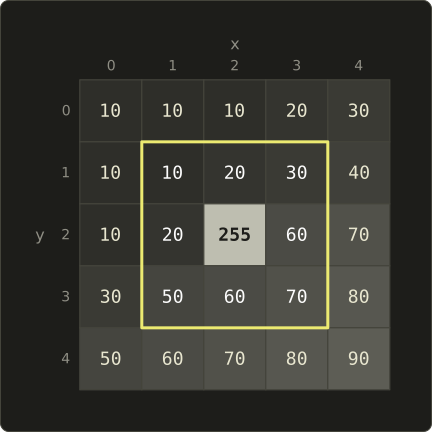
The figure shows a 5 × 5 part of an 8-bit grayscale image, with x to the right and y down.
The value 255 at the center pixel is a noise spike, and the yellow frame marks its 3 × 3 neighborhood.
(1) What does a 3 × 3 median filter output at the center pixel?
| A | 30 |
| B | 50 |
| C | 60 |
| D | 64 |
| E | 255 |
(2) The Sobel filter is applied at the center pixel: is the right column minus the left column and the bottom row minus the top row, both weighted 1, 2, 1. What is the gradient magnitude ?
| A | 120 |
| B | 160 |
| C | 200 |
| D | 280 |
| E | 40000 |
(3) The (a) filter weights each neighbor by both its distance from the center and the difference between its value and the center's value, so it smooths noise while keeping edges sharp. Which filter goes in (a)?
| A | Gaussian |
| B | median |
| C | bilateral |
| D | Laplacian |
| E | Sobel |
(4) Which of the following statements is wrong?
| A | Dilation grows the shapes in a binary image, and erosion shrinks them. |
| B | With zero padding at the border, smoothing darkens the border of the image; clamping or mirroring avoids this. |
| C | A separable kernel, such as a box or a Gaussian, can be applied as two 1D passes, with instead of multiplications per pixel. |
| D | Opening, a dilation followed by an erosion, fills small holes in a binary image. |
| E | Unsharp masking adds to the image ; it steepens edges, and too large a creates halos. |
Problem 9: Computational photography, NPR and visualization
A phone's camera software combines several frames into one photo and resizes images by content, a game uses a stylized renderer, and a hospital uses a tool that visualizes CT data.
(1) A single frame of a static scene has noise with a standard deviation of 8 (in pixel values). The software aligns and averages frames whose noise is independent. How many frames must it average to reduce the standard deviation to 2?
| A | 2 |
| B | 4 |
| C | 8 |
| D | 12 |
| E | 16 |
(2) For seam carving, the software has computed this energy map of a 5 × 4 image:
| x = 0 | x = 1 | x = 2 | x = 3 | x = 4 | |
|---|---|---|---|---|---|
| y = 0 | 4 | 1 | 9 | 5 | 3 |
| y = 1 | 5 | 6 | 6 | 2 | 4 |
| y = 2 | 2 | 8 | 1 | 5 | 4 |
| y = 3 | 5 | 7 | 9 | 3 | 5 |
A vertical seam takes one pixel per row, and the pixels in neighboring rows must be 8-connected (their x differs by at most 1). Which seam, given as its x in the rows y = 0, 1, 2, 3, has the smallest total energy?
| A | (1, 0, 0, 0) |
| B | (1, 3, 2, 3) |
| C | (4, 3, 2, 3) |
| D | (1, 1, 2, 3) |
| E | (3, 3, 3, 3) |
(3) Which of the following statements about NPR is wrong?
| A | A crease edge depends on the viewpoint, so the crease edges of a mesh must be detected again every frame. |
| B | Toon shading quantizes into a few levels with thresholds or a ramp texture. |
| C | Outlines can be found in image space by edge detection on the depth, normal or object ID buffers. |
| D | Stippling draws darker tones with more dots per area. |
| E | Gooch shading blends from a cool color to a warm color with , which suits technical illustration. |
(4) Which of the following statements about visualization is correct?
| A | The lightness of a rainbow color map increases steadily with the value, which makes it the best choice for ordered data. |
| B | Maximum intensity projection gives strong depth cues, because it composites the samples from front to back. |
| C | Information visualization deals mainly with data that have positions in physical space, such as CT volumes. |
| D | An isosurface shows many values of a volume at once, semi-transparently. |
| E | In direct volume rendering, a transfer function maps each data value to a color and an opacity. |
Problem 10: CG systems, perception, intellectual property and history
A small company develops a 3D scanner with a stereo camera and the software that renders its scans in real time, and wants to protect and sell the product.
(1) The stereo camera has two identical cameras with parallel optical axes, a baseline of 0.1 m and a focal length of 800 pixels. A point has a disparity of 16 pixels. How far away is it?
| A | 0.2 m |
| B | 5 m |
| C | 10 m |
| D | 80 m |
| E | 1280 m |
(2) Which of the following statements about industrial property rights under Japanese law at the time of writing is correct?
| A | A patent lasts, in principle, 20 years from the filing date. |
| B | A design right lasts 10 years from registration and can't be renewed. |
| C | A trademark right lasts 10 years from registration and can't be renewed. |
| D | Like copyright, patents, utility models, designs and trademarks are protected automatically, without registration. |
| E | A utility model right is granted after a substantive examination and lasts 20 years from filing, like a patent. |
(3) Which list puts these four techniques in chronological order, oldest first? P: Gouraud shading. Q: the Z-buffer method (Catmull). R: ray tracing (Whitted). S: the rendering equation (Kajiya).
| A | Q → P → R → S |
| B | P → R → Q → S |
| C | R → P → Q → S |
| D | P → Q → R → S |
| E | P → Q → S → R |
(4) Which of the following statements is wrong?
| A | Deferred rendering writes a G-buffer first and then lights each pixel; it handles many lights well but semi-transparent surfaces poorly. |
| B | Tile-based rendering, common in mobile GPUs, processes the screen in tiles kept in on-chip memory, which saves bandwidth and power. |
| C | On a GPU with SIMT execution, when the threads of one warp take different branches, each thread runs only its own branch, at no extra cost. |
| D | In structured light with Gray-code patterns, the codes of neighboring stripes differ in exactly one bit. |
| E | In a head-mounted display, the eyes converge at the virtual depth of an object but focus at the fixed distance of the display's image, which causes the vergence–accommodation conflict. |
30.2 When you're done
Stop when the 80 minutes are up, and only then turn to chapter 31 to check your answers, count your score and see which sections to review.
コメント(0)
まだコメントはありません。
ログインするとコメント出来ます。